Distance has an economic cost that cannot be read from a shipping invoice. A replacement component moving between continents may occupy very little space in a cargo hold while its absence keeps an entire production line idle, leaves employees waiting, and delays orders further along the supply chain. The manufacturer is paying for the transportation of the component, but it is also paying for the time during which that component remains unavailable. Once those costs are considered together, a more expensive journey can become the less expensive business decision.
The possibility of reducing that burden becomes particularly interesting when we look above the transportation systems we ordinarily use. The International Space Station travels at approximately 17,500 miles per hour and circles Earth roughly every ninety minutes, according to NASA. Its passage across the night sky offers a visible reminder that the time required to cross great distances depends on the technological system doing the crossing. Turning that observation into a freight service, however, requires solving the considerably more demanding problem of launching, transporting, recovering, and delivering cargo reliably enough for someone to organize a business around it.
Reusable rockets raise the prospect of another transportation layer within global commerce, allowing selected shipments to move between distant regions on timescales that conventional freight networks cannot readily provide. Whether that capability becomes commercially useful will depend on how much economic value is recovered by saving time, how consistently the service can operate, and what must be built around the vehicle to make the journey possible. The implications reach into industrial location, inventory management, infrastructure investment, and the productive capacity of regions whose distance from suppliers currently imposes a substantial penalty.
An emerging capability with an unfinished business model
Rocket transportation between locations on Earth has already attracted serious institutional attention. The Department of the Air Force announced Rocket Cargo as a Vanguard program in June 2021, with research directed toward the use of commercial launch capabilities for defense logistics. The work extended beyond the rocket to questions such as cargo loading, unloading, reentry, and landing near the locations where supplies would actually be needed. Those are precisely the operational questions that separate a transportation demonstration from a useful logistics service.
A later example is Rocket Lab's May 2025 announcement of an Air Force Research Laboratory contract for a Neutron mission involving a cargo survivability experiment and reentry under the Rocket Experimentation for Global Agile Logistics solicitation. The announcement documents a research commitment; it provides no basis for treating regular intercontinental freight delivery as an established commercial service. It does, however, show that the underlying proposition has progressed far enough to justify work on specific parts of the transportation problem.
Military interest also helps explain the likely shape of an early market. Restoring a lost operational capability or delivering urgently needed equipment can justify an expense that ordinary commercial freight cannot support, while governments may accept development costs and operational constraints that private shippers would find prohibitive. A useful defense application could therefore emerge well before a broadly competitive commercial network, and its existence would still leave the commercial economics to be demonstrated.
The flight occupies one part of a much longer journey
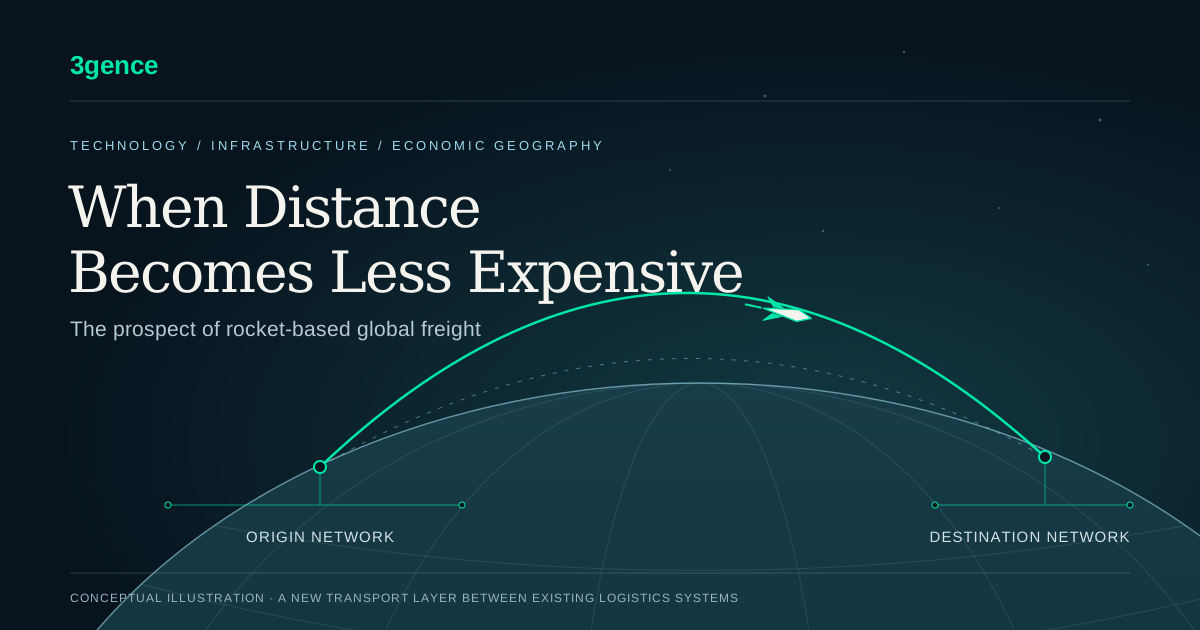
The most straightforward version of the concept would use a reusable vehicle following a suborbital trajectory between a departure facility and a destination facility. A sustained orbit would introduce different energy requirements, flight planning, and recovery considerations, and neither architecture can be evaluated simply by borrowing the orbital speed of the space station. The distance between the facilities, the vehicle's performance, the allowable trajectory, and the landing requirements would determine the actual flight profile.
Before that flight could begin, cargo would have to move from factories or warehouses to a compatible terminal, pass inspection and clearance, and be secured in modules designed for the vehicle. Loading, propellant availability, launch preparation, weather, and access to the required flight corridor would all influence when departure became possible. Upon arrival, the cargo would need to be recovered, unloaded, processed, and transferred into the destination's transportation network before trucks, rail, regional aircraft, or other vehicles completed delivery.
A prospective flight lasting an hour or two could consequently sit inside a delivery process lasting much longer. Consider a shipment from the United States to Brazil, or a specialized component moving from a Chinese supplier to an industrial facility in Angola: even if the principal intercontinental leg became extraordinarily fast, the distance between the customer and the receiving terminal would still matter. These are illustrative routes rather than operating services or delivery-time forecasts, but they make the logistical problem easier to see.
Customers would ultimately purchase dependable access to an earlier delivery, which means waiting for a launch could erase much of the advertised speed advantage. A service that requires several days to assemble a commercially viable payload may arrive later than an aircraft that leaves tonight. The economically relevant measurement is therefore the time from a customer's need becoming known to the cargo becoming available at the place where it will be used, including the variability surrounding that time.
Where the cost of waiting could justify the cost of flight
The scale of ordinary freight places an immediate limit on expansive claims about rocket logistics. UN Trade and Development estimates that around eighty percent of international trade in goods, measured by volume, moves by sea, reflecting the ability of maritime transport to move enormous quantities at costs that most goods can bear. Grain, ore, ordinary manufactured products, and the contents of a typical container shipment generally gain too little from saving a day to justify anything resembling rocket transportation costs.
Payload claims also require care. SpaceX describes Starship as designed to carry more than one hundred metric tons to orbit in a fully reusable configuration; a published design objective for orbital missions does not establish how much saleable freight a particular Earth-to-Earth route could deliver. For an illustrative comparison, suppose a future system delivered between one hundred and one hundred fifty metric tons of usable cargo. At an assumed twenty metric tons of cargo per truck, that would represent roughly five to seven and a half truckloads by mass, with cargo volume and packaging potentially imposing tighter limits. Moving twenty to fifty such truckloads would require multiple flights or a different vehicle scale.
A more useful commercial comparison is premium air freight, particularly when the absence of a relatively small shipment creates a disproportionate operational loss. An industrial component, a specialized instrument, or equipment needed to restore an essential service may be worth transporting at an exceptional price because of what becomes possible when it arrives. The purchase price of the object is only one consideration; the economic activity depending on its availability may matter considerably more.
The buyer's calculation would combine the shipping charge with the cost of interrupted production, capital tied up in inventory, spoilage where relevant, and the expected consequences of damage or late arrival. A rocket service could command a premium when it reduced that combined burden sufficiently, although comparable improvements might sometimes be achieved through better inventory placement, an alternative supplier, local manufacturing, or a conventional express flight. Commercial demand would depend on how the proposed service performed against those actual alternatives.
This also explains why the title's prospect of distance becoming less expensive should be understood in economic terms. A shipment might cost considerably more to transport while leaving the customer with a lower overall loss, because a distant supplier had become accessible within an operationally useful period. Sustained demand would arise from that relationship between time and value, and it could remain concentrated in a narrow set of customers even after the technology improved substantially.
The logistics spaceport would be an industrial system
The development of a useful freight network would place considerable economic importance on the facilities supporting it. Seaports, airports, and rail terminals draw businesses toward them because they connect production with markets, while their surrounding roads, warehouses, maintenance services, and workforce capabilities determine how much of that access firms can actually use. A logistics spaceport would enter this same economic geography with an unusually demanding set of operational requirements.
Such a facility would combine launch and recovery infrastructure with propellant storage, vehicle servicing, specialized engineering, cargo handling, communications, and links to regional transportation. Its commercial usefulness would also depend on customs processing, security, insurance, scheduling, and the authority to conduct the intended operations. In the United States, the FAA distinguishes the authorization of launch and reentry operations from the licensing of launch and reentry sites, illustrating how the physical facility and the services using it require connected but distinct approvals.
Location would consequently involve tradeoffs that ordinary distribution centers seldom encounter. Proximity to customers could conflict with requirements involving population exposure, noise, flight trajectories, and exclusion areas, while a remote coastal site might simplify some operational questions and create expensive ground transportation problems. The FAA's environmental review materials for Starship operations at Boca Chica already illustrate the attention required for airspace closures, landing trajectories, and environmental effects. A frequent international freight operation would have to incorporate such constraints into its service design from the beginning.
This could create an opening for a region that occupies a peripheral position in existing trade networks but possesses an appropriate site, dependable energy, and strong transportation connections. The opening would become economically consequential only if local institutions and businesses developed the capacity to serve the activity around it: technicians capable of maintaining equipment, manufacturers able to supply components, freight operators able to manage the transfer, and public administrations capable of coordinating development competently. A launch facility surrounded by weak connections could remain an impressive installation with relatively modest local economic effects.
Regional leaders would therefore need to evaluate the industrial system that could plausibly develop, including its customers and recurring demand, before treating a spaceport as an economic-development strategy. The relevant investment might be an intermodal connection, a workforce program, or a supplier capability that also serves existing industries. Those investments can retain value across several possible futures, whereas infrastructure dependent on an unproven flight schedule carries a much narrower justification.
Faster access would rearrange geographic advantage
Transportation changes the range of activities that can be coordinated across distance. Railroads connected inland production with larger markets, highways changed the location of manufacturing and distribution, and containerization made dispersed production networks easier to organize. The economic importance of those systems emerged as businesses adjusted their operations around access that had become more reliable, less costly, or both. Rocket freight would have to earn a place in that history through similarly useful changes in the decisions firms can make.
A manufacturer several days removed from a specialized supplier might reconsider how much expensive replacement equipment it stores locally if it could reliably obtain a replacement within hours. A research institution could potentially coordinate work requiring the rapid movement of particular instruments, while emergency-response organizations might gain an additional option for moving suitable cargo between continents. These possibilities remain conditional on the equipment surviving the journey and the destination possessing the facilities necessary to receive it; the urgent need for a shipment does not by itself create a usable landing site.
The same reasoning suggests that faster transport would create new concentrations of advantage. Regions with dependable service and strong ground connections could become better positioned for activities in which rapid international access commands a high value, while areas distant from those gateways would continue to bear the cost of reaching them. Supplier relationships, skilled labor, utilities, institutions, and domestic transportation would remain consequential even as one portion of the distance penalty diminished. Geography would continue to exert its influence through a different arrangement of infrastructure.
The energy and operating requirements would remain substantial
Reusing a rocket can spread the cost of manufacturing the vehicle across more flights, but each flight still requires propellant and the work of preparing, operating, inspecting, and servicing the system. A network offering frequent departures would need reliable propellant supply, appropriate storage and handling, adequate power, and maintenance capacity matched to its promised schedule. Vehicle lifetime and the cost of refurbishment would influence the economics as much as the number of times the word “reusable” appeared in a presentation.
Environmental performance would also have to be evaluated across the complete operation, including propellant production, emissions, noise, and the effects of repeated launches and landings. A shorter journey time provides no independent evidence of lower energy consumption or emissions per delivered ton, and the relevant comparison would depend on the cargo carried, the route, the vehicle, and the alternatives. Commercial and public decisions would require that accounting alongside the value created by greater speed.
Utilization introduces another difficulty because the locations urgently needing cargo on a particular day may have little freight ready for a return journey. Operators would have to account for repositioning, uneven demand, cargo compatibility, available payload volume, and the time required to assemble each shipment. An aircraft or vessel already spreads similar costs across an established transportation network; a rocket operator would need to demonstrate how its own network could carry those costs without pricing most prospective customers out of the service.
Commercial viability would require the whole system to mature
The transition toward a commercial sector would depend on several capabilities improving together. Lower launch costs would need to be accompanied by dependable vehicle turnaround, predictable departure opportunities, and standardized cargo systems that could be loaded and unloaded efficiently. The goods themselves would require qualification for the acceleration, vibration, thermal protection, packaging, and handling conditions of the service. A nominal payload capacity could produce much less useful commercial capacity once those requirements were included.
International operation would add coordination among launch and reentry authorities, airspace managers, customs agencies, environmental regulators, and national security institutions. A physical route between two points would have to become an authorized and insurable service connecting two functioning logistics systems, with contractual responsibilities clear enough that customers could rely on the promised result. This institutional work would shape both the speed available to a customer and the cost of supplying it.
The final discipline would come from customers willing to purchase the service repeatedly at a price that covered its costs. A successful demonstration could establish a technical capability while leaving uncertain the number of routes, departure frequency, and volume of demand a business could sustain. It is entirely plausible that useful military or specialized commercial applications could coexist with many years in which ordinary freight continued moving through familiar ports and airports. That outcome would still leave room for a consequential innovation within the portion of the economy it could serve effectively.
The economic meaning of distance
The broader significance of rocket freight lies in the way a new capability could change decisions beyond transportation itself. If access to an essential component became sufficiently fast and dependable, a firm might hold a different inventory, choose a different supplier, support a more distant facility, or restore production sooner after a failure. Those changes would transmit the value of transportation into investment, industrial organization, and the economic possibilities available to particular regions.
The commercial prospect remains uncertain because every one of those decisions depends on a service that must work repeatedly outside the conditions of a demonstration. Nevertheless, it deserves serious examination through the same lens we should apply to other emerging technologies: what productive capability becomes possible when the technology is joined to adequate infrastructure, workable institutions, and a sound operating model? For selected forms of freight, a credible answer could eventually mean that a supplier remains thousands of miles away while the economic cost of that separation becomes substantially smaller.
Sources and analytical scope
This article develops the commercial and regional implications of a prospective transportation capability. Illustrative routes and payload comparisons are assumptions for analysis, rather than service announcements, verified delivery capacities, or cost forecasts.
- NASA, Spot the Station frequently asked questions.
- Department of the Air Force, announcement of the Rocket Cargo Vanguard program, June 2021.
- Rocket Lab, Air Force Neutron reentry mission announcement, May 2025.
- SpaceX, Starship design overview.
- UN Trade and Development, Review of Maritime Transport.
- Federal Aviation Administration, commercial space licenses, permits, and approvals, and Starship environmental review materials.